
Saturday, May 16, 2009
Friday, April 10, 2009
Chimpanzees exchange meat for sex

BBC News, April 07, 2009
Chimpanzees enter into "deals" whereby they exchange meat for sex, according to researchers.
Male chimps that are willing to share the proceeds of their hunting expeditions mate twice as often as their more selfish counterparts.
This is a long-term exchange, so males continue to share their catch with females when they are not fertile, copulating with them when they are. The team describe their findings in the journal PLoS One. Read more...
Male chimps that are willing to share the proceeds of their hunting expeditions mate twice as often as their more selfish counterparts.
This is a long-term exchange, so males continue to share their catch with females when they are not fertile, copulating with them when they are. The team describe their findings in the journal PLoS One. Read more...

Tuesday, April 7, 2009
Social Ecology articles available
Previously unavailable works by social ecologists Peter Staudenmaier, Ben Grosscup, and Karl Hardy covering a broad range of topics can now be accessed in the Institute for Social Ecology’s website Article Archive.
Staudenmaier’s pieces include his critical historical essays on anthroposophy, his participation in Left debates over Kosovo, and his involvement in a “Social Ecology vs. Participatory Economics” debate with Michael Albert, the founder of PARECON.
The two articles authored by Grosscup posit a radical critique of the response to Hurricane Katrina and the 2004 election cycle, respectively.
Hardy offers a book review of the posthumously-released “Social Ecology and Communalism,” a collection of essays by Murray Bookchin, and an analysis of progressive candidacies during the 2008 US presidential race.
Peter Staudenmaier's articles:
http://www.social-ecology.org/author/peter-staudenmaier/
Ben Grosscup's articles:
http://www.social-ecology.org/author/ben-grosscup/
Karl Hardy's articles:
http://www.social-ecology.org/author/karl/
Staudenmaier’s pieces include his critical historical essays on anthroposophy, his participation in Left debates over Kosovo, and his involvement in a “Social Ecology vs. Participatory Economics” debate with Michael Albert, the founder of PARECON.
The two articles authored by Grosscup posit a radical critique of the response to Hurricane Katrina and the 2004 election cycle, respectively.
Hardy offers a book review of the posthumously-released “Social Ecology and Communalism,” a collection of essays by Murray Bookchin, and an analysis of progressive candidacies during the 2008 US presidential race.
Peter Staudenmaier's articles:
http://www.social-ecology.org/author/peter-staudenmaier/
Ben Grosscup's articles:
http://www.social-ecology.org/author/ben-grosscup/
Karl Hardy's articles:
http://www.social-ecology.org/author/karl/
Thursday, March 26, 2009
Travis died for your sins
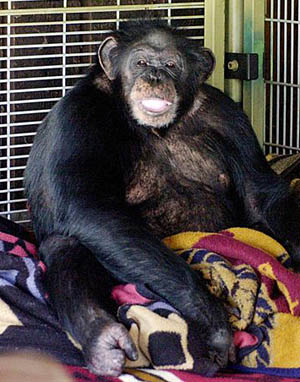
Travis the chimpanzee, a veteran of TV commercials, was the constant companion of a lonely Connecticut widow who fed him steak, lobster and ice cream. He could eat at the table, drink wine from a stemmed glass, use the toilet, and dress and bathe himself. He brushed his teeth with a Water Pik, logged on to a computer to look at photos and channel-surfed television with the remote control. But on Monday, the wild animal in him came out with a vengeance. The 200-pound animal viciously mauled a friend of his owner before being shot to death by police... Read the full article...
Tuesday, March 24, 2009
Παγίδα για τα άγρια ζώα η Εγνατία

Παγίδα θανάτου για τα άγρια ζώα αποδεικνύεται η Εγνατία. Μετά τις αρκούδες που πέφτουν θύματα τροχαίων, ένας λύκος χτυπήθηκε επίσης από διερχόμενο αυτοκίνητο στην περιοχή Γρεβενών. Διαβάστε όλο το άρθρο...
Monday, March 9, 2009
Zoo chimp 'planned' stone attacks

BBC News, March 09, 2009
A male chimpanzee in a Swedish zoo planned hundreds of stone-throwing attacks on zoo visitors, according to researchers. Keepers at Furuvik Zoo found that the chimp collected and stored stones that he would later use as missiles.
Further, the chimp learned to recognise how and when parts of his concrete enclosure could be pulled apart to fashion further projectiles. The findings are reported in the journal Current Biology. Read more...
Further, the chimp learned to recognise how and when parts of his concrete enclosure could be pulled apart to fashion further projectiles. The findings are reported in the journal Current Biology. Read more...
Friday, March 6, 2009
End the Use of Chimps in Research
The Humane Society of US, March 05, 2009
A nine-month-long undercover investigation by The HSUS has exposed the mistreatment of nearly 300 chimpanzees and other primates at the New Iberia Research Center (NIRC) in Louisiana. These chimps, living lives of deprivation and misery, are among the more than 1,000 chimps languishing in laboratories across the United States. Chimps, our closet genetic relative, are complex, social, and long-lived creatures. Many chimps currently warehoused in research facilities have lived for decades behind bars. Especially heartbreaking are stories of the 26 elder chimps at NIRC, who were taken from their mothers in the wild. Read more...
A nine-month-long undercover investigation by The HSUS has exposed the mistreatment of nearly 300 chimpanzees and other primates at the New Iberia Research Center (NIRC) in Louisiana. These chimps, living lives of deprivation and misery, are among the more than 1,000 chimps languishing in laboratories across the United States. Chimps, our closet genetic relative, are complex, social, and long-lived creatures. Many chimps currently warehoused in research facilities have lived for decades behind bars. Especially heartbreaking are stories of the 26 elder chimps at NIRC, who were taken from their mothers in the wild. Read more...
Subscribe to:
Posts (Atom)